


Notice
You are now leaving the Third Avenue Management website and being connected to a third-party website. Please note that Third Avenue Management is not responsible for the information, content or products(s) found on third-party websites.
Notice
Third Avenue Management is aware of recent incidents involving unauthorized individuals and groups falsely claiming to represent Third Avenue Management and its affiliates through social media platforms, messaging applications, email, and fraudulent websites. In some cases, these bad actors have used the names, photographs, or identities of Third Avenue employees in an attempt to appear legitimate.
These individuals and websites are not affiliated with, sponsored by, or endorsed by Third Avenue Management.
Third Avenue Management does not solicit investments, provide investment recommendations, or request personal or financial information through social media platforms or messaging applications such as WhatsApp, Telegram, Signal, or similar services.If you receive a suspicious communication claiming to be from Third Avenue Management, we encourage you to verify its authenticity before responding or providing any personal or financial information. If you are unsure whether you are communicating with an authorized representative of Third Avenue, please contact us directly using the contact information available on our official website.
Third Avenue Management, its affiliates, directors, officers, employees, and agents are not responsible for communications, representations, or activities conducted by unauthorized third parties. If you believe you have been the target of an impersonation or investment scam, or that you or someone you know has been a victim of fraud, please contact your local law enforcement agency and report the incident to the appropriate authorities. In the United States, suspected internet fraud can also be reported to the Federal Bureau of Investigation's Internet Crime Complaint Center (IC3) at https://www.ic3.gov/.
Notice
You are now leaving the Third Avenue Management website and being connected to a third-party website. Please note that Third Avenue Management is not responsible for the information, content or products(s) found on third-party websites.
September 30, 2026
Small-Cap Value Fund
Small-Cap Value Fund Q326


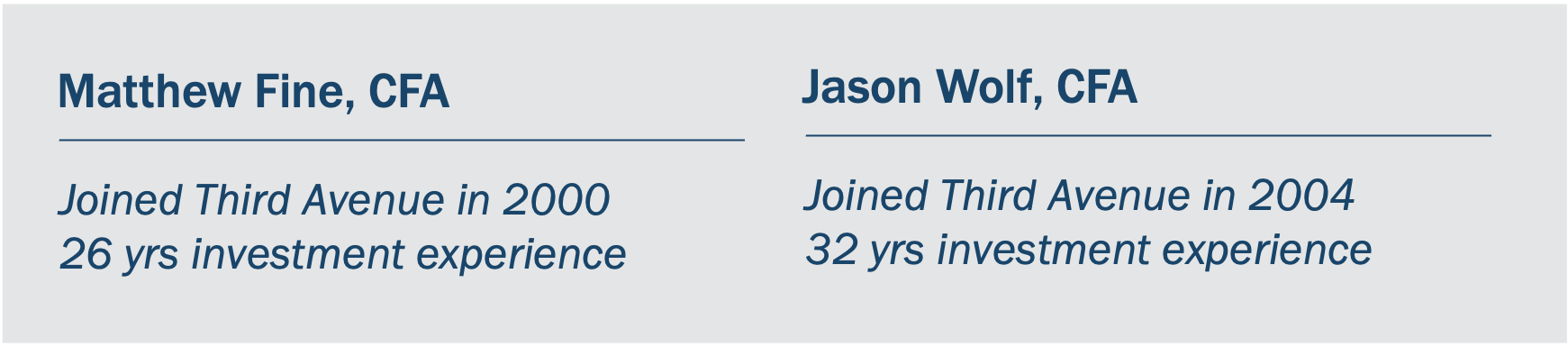

Dear Fellow Shareholders,
The Third Avenue Small-Cap Value Fund (the “Fund”) returned -3.31% during the third quarter of 2026, as compared to a return of -4.25% for the MSCI USA Small Cap Value Index1. Year-to-date, the Third Avenue Small-Cap Value Fund returned 17.69%, as compared to a return of 10.98% for the MSCI USA Small Cap Value Index. U.S. small-cap equities have continued to hold on to strong year-to-date gains, even after retreating from August levels, and are on track for one of their best performances relative to U.S. large-cap indices, such as the S&P 500 Index, in the last decade. Still, if valuation carries any predictive value, and we believe it does, the prospects for relative performance of U.S. small-cap stocks, compared to U.S. large-caps, continue to look very promising.
PERFORMANCE & PHILOSOPHY
During the third quarter, Fund performance benefited from diversified sources of return. Leading contributors to performance included petroleum refiner PBF Energy, cybersecurity specialist Qualys, offshore energy services company Tidewater, government contractor ICF International and staffing company Robert Half. Tidewater’s strength is, in our view, attributable to higher energy prices and related fears of potential global energy shortages, which may add a tailwind to an already building offshore energy investment cycle. Qualys’ share price recovery from earlier in this year takes place on the back of the launch of its new A.I.-driven vulnerability detection platform. Both Qualys and Robert Half share a few similarities in the sense that the Fund’s initial purchase of both companies took place at materially lower prices during the second quarter of this year, and in the sense that a tempering of the most acute A.I.-related business disruption fears have significantly aided their share prices since then. Robert Half specifically has been gaining the attention of investors as U.S. employment data has begun to offer some encouraging signs as it relates to stabilization and nascent recovery of volumes of temporary staffing, in which Robert Half specializes, from a deep cyclical low.
Detractors from performance during the quarter were equally disparate. Healthcare company Collegium Pharmaceutical was the largest detractor as a sensible, ongoing strategic shift of its business mix away from pain management towards ADHD medications continues to develop. Insurance business Octave Specialty Group was the second largest negative contributor. That Octave Specialty Group should find itself among our leading detractors list is somewhat counterintuitive. The company has made considerable progress transforming its business into a strong insurance distribution platform, a desirable and growing business which can offer attractive returns on capital. Also, rising interest rates arguably have two positive benefits for Octave. While the company is primarily an insurance distributor, it does retain some insurance exposure on its balance sheet, which leads to an investment portfolio that may produce higher income in a higher interest rate environment. Similarly, the insurance company clients of Octave’s distribution businesses are also beneficiaries of higher yields in the same way. All else equal, higher yielding investment portfolios tend to make insurance companies more eager to write larger amounts of business, with somewhat more relaxed underwriting standards, which should be supportive of Octave’s origination volumes. Infrastructure engineering company MYR Group, North American aluminum products manufacturer Kaiser Aluminum, and regional bank Flagstar Bank also detracted from performance during the quarter.
The single largest contributor to Fund performance for the quarter was PBF Energy. At the time of the Fund’s initial investment, roughly two years ago, we held the view that PBF’s assets, and U.S. refinery assets in general, were at that time earning well below normalized margins and returns. We believed that, given the absolutely critical nature of the assets and a wave of U.S. refining capacity closures in recent years, there was a high probability that the economics of that industry would eventually rise to a level at which reinvestment to maintain the production capacity of the remaining refinery assets could be economically justified.
Furthermore, asset attrition has a way of cyclically correcting the economics of a business, which seemed particularly likely for some of the U.S. West Coast and East Coast assets in which PBF has an unusually large exposure. The U.S. West Coast and Northeast are regions particularly reliant upon imported petroleum products, diesel for example, even while the U.S in aggregate has become a large net exporter of diesel. Considerable disruption to energy flows and destruction of Russian refinery assets has cast a bright light on the fragility of the global energy fuel distribution system. Within the United States, a lack of infrastructure connectivity among regions can and has caused huge pricing differentials, as have supply disruptions to specific types of feedstock refineries are designed to process. In turn, the indispensable nature of these very large, expensive and tangible assets has been brought into view. In the meantime, refiners in general, and PBF in particular, are enjoying enormous cash flows. In the next quarter or two, we believe it is likely that PBF will disclose a balance sheet that has achieved a net cash position. To be clear, notwithstanding the very strong performance of PBF stock during 2026, it is apparent that investors are not extrapolating recent operating performance and embedding the present level of returns into the share price, nor should they. Based on current and anticipated levels of free cash flow, the company is trading at a low-to-mid-single digit multiple of free cash flow. That is interesting because the extent of cash flow generation has completely deleveraged PBF’s balance sheet and the company continues to produce cash at such a prodigious clip that the enterprise value of the company is currently changing meaningfully over very short periods of time. That won’t last forever but it opens the door to several forms of future shareholder value creation for PBF that would previously have been out of the question.
THE PRICE OF MONEY MATTERS, ESPECIALLY FOR SMALL-CAPS
In recent years, our team has interacted with many clients and prospective clients. One common theme has been an appreciation, on their part and ours, for the high degree of undervaluation of U.S. small-cap companies relative to large-cap companies. Valuation spreads between the two have been extreme in recent years, indisputably so in our view. Another common theme has been a growing appreciation for the huge concentrations of certain types of businesses within large-cap indices, information technology and A.I.-related hyperscalers, for example. In reality, it is all the same phenomenon: the stocks of very large U.S. information technology companies performing well, appreciating rapidly in valuation, and coming to comprise a huge concentration of large-cap indices. In other words, the historical outsized stock performance has created high valuations and high concentrations. Somewhat frequently, that conversation would conclude with the prospective client saying something to the effect of, “yes, we see the world in a similar way but tell me when it will stop.” Alas, there is no dinner bell alerting us at the right time to invest.
A few of the more enterprising asset allocators with whom we have relationships use allocation models that strive to identify preferable times to add to small-caps or add to large-caps depending upon various interest rate dynamics. For example, a few perceive the beginning of a cycle of declining interest rates to be an important signal that it is time to increase exposure to small-caps. We do not believe that a historical analysis supports that approach and, in our view, it is challenging to see the efficacy of such an approach in recent years as low and falling interest rates coincided with one of the most extraordinary runs of large-cap outperformance in many decades. Further, small-caps have shown significant relative strength in 2026, a year in which government and corporate bond yields have been rising sharply. We view the extraordinarily attractive relative valuation of small-cap stocks at the beginning of this year as the far more impactful cause of small-cap outperformance, rather than any interaction with the interest rate environment.
That said, we do think interest rates and the cost of borrowing matter a lot for small-cap investors, though for a very different set of reasons. A sharp increase in U.S. borrowing costs over the last five years has been dramatic and is clearly beginning to manifest in higher incidence of credit stress. Even though U.S. treasury yields have only risen to levels that are relatively normal by historical standards, signs of credit stress have clearly increased. Credit deterioration is clearly visible in private credit, leveraged loans, junk bond yield spreads, high profile failures of asset-backed borrowers and delinquencies in some areas of consumer credit. U.S. bankruptcy filings have increased each year since 2022 and are on pace in 2026 to well exceed the number of filings last year. While it may not be wrong to characterize some of these developments as a shift towards normalcy, borrowing costs have increased markedly and are having a material impact on credit markets.
Moreover, balance sheet quality has always mattered, and we have been unerring in that view for our firm’s entire 40-year history. However, a recent return to a world in which borrowing money actually costs money, and money may not be available for everyone in any quantity, balance sheets matter even more. Our strong view is that this importance is further amplified within the context of small-cap investing. In short, each of the ways in which balance sheets matter in equity investing is heightened by characteristics of the small-cap universe and small-cap companies in general:
Index Composition – There are several well-known U.S. small-cap indices. We reference a few of them in these letters from time to time. They are not all created equal. Some of the most well-known and tracked indices employ no criteria whatsoever in consideration of a lack of profitability or very high levels of indebtedness. Estimates suggest that in excess of 40% of Russell 2000 Index constituents are unprofitable. The size of index exposure to unprofitable and highly indebted companies is large and quite plain to see. It should also be noted that U.S. small-cap companies have far more exposure to floating rate debt than U.S. large-cap companies, which generally benefit from more favorable access to capital markets. For some indices, average company indebtedness has also gotten materially worse in recent years. This is an opportunity for active managers to separate themselves in a positive way from index performance. In other words, one can sign off on the relative attractiveness of small-cap valuations in general, but that leaves open the question of how one allocates capital to implement that view. We think there are many good arguments for active management in small-cap investing, and the ability to add value through balance sheet analysis is certainly among them.
To be clear, debt is simply an accelerant. Whatever is going to happen for a company, for better or worse, will be increased in speed and amplitude through the use of financial leverage. For that reason, the benefits of caring about balance sheet quality are likely to be more apparent in the form of downside protection than in the strategy’s upside capture. We believe the Fund’s performance record across time provides evidence of this concept.
Business & Geographic Concentration Risk – In general, smaller companies are often more narrowly focused on single lines of business and are often focused exclusively on a national or even regional market. As compared to large U.S. companies, which are frequently diversified across business lines and global in scope, small-caps are often far less diversified. On one hand, this can make smaller, narrowly focused companies far easier to analyze; it can also mean a far larger impact upon the enterprise when something goes wrong. This argues strongly for small-cap management teams and boards of directors of smaller companies to take a conscientious approach to a lack of business diversification. A conscientious approach would necessarily include the maintenance of a strong balance sheet, in our view.
As an aside, the recent operating performance of U.S. small-cap companies has been very strong by most measures, growing revenues and earnings at very strong rates, exceeding that of U.S. large-caps by some measures. However, this is not necessarily a permanent condition or an uninterruptable intrinsic characteristic.
Reduced Access to New Capital – For many reasons, including those noted in the ‘Business & Geographic Concentration Risk’ section above, the ability of smaller U.S. companies to raise new capital as needed pales in comparison to large U.S. companies. In addition to fundamental business concentration risk, smaller companies tend to have less investment banking support for smaller debt and equity issuances, are less likely to be active issuers in credit markets, have a more challenged relationship with ratings agencies because of business concentration risk, and often have less extensive asset bases which can serve as borrowing collateral. In addition, investor expectation of higher security price volatility of small issuances from small companies often leads to a far higher cost of capital.
In summary, capital markets can be notoriously capricious, and even more so for smaller companies. This increases the risk that additional capital will not be available to a small company at precisely the moment it is most needed. Needing to access capital from a weakened position on usurious terms is a terrific way to destroy shareholder value. Maintaining balance sheet strength and financial self-sufficiency is as close to a panacea as one will find in financial markets.
Shareholder Wealth Creation Through Resource Conversion – We would be remiss if we left readers with the impression that balance sheet strength only serves to mitigate risks and pitfalls inherent to small-cap investing. In addition to income from operations, there are myriad ways that companies and their management teams create shareholder wealth. At Third Avenue Management we refer to these activities – such as acquisitions, divestitures, stock buybacks, spin-offs, recapitalizations, special dividends, monetization of latent assets, etc. – as resource conversions. The potential to create shareholder wealth through clever resource conversion activity is a heavy focus of our analytical effort and often a significant component of the strategy’s returns. Balance sheet resources are the feedstock for these opportunities. In general, the greater the quantity and quality of balance sheet resources, the more opportunity to create value. Well-financed balance sheets offer control over the timing at which capital is accessed and at which transactions are executed. As mentioned above, accessing capital or conducting a transaction from a position of necessity, likely brought on by business challenges, is an excellent way to destroy shareholder wealth. Conversely, the ability to execute upon acquisitions or share repurchases countercyclically, when times are challenging and valuations deeply depressed, is a terrific way to create significant shareholder wealth, in our view.
While this approach is central to Third Avenue’s philosophy and is applied to all Third Avenue strategies, there is an argument to be made that opportunities for wealth creation through resource conversion are most robust in U.S. small-cap investing. Security price volatility and less efficient price discovery lends itself to opportunistic M&A activity. More challenging and capricious availability of new capital lends itself to distress and increases a well-financed company’s opportunity to enhance its competitive strength on the back of its financial strength or otherwise consolidate an industry. Less efficient security pricing and thinner analytical coverage also increase the potential for opportunities to repurchase stock at irrational prices. Furthermore, regulatory burdens to companies being taken over are less onerous and many public small-cap companies are of a size that puts them into the sweet spot for private equity takeovers.
So far during 2026, four of the Fund’s holdings have agreed to be acquired. Tri Pointe Homes, a U.S. homebuilder, was acquired by Japanese homebuilder Sumitomo Forestry. Catalyst Pharmaceuticals, a biopharmaceuticals company, was acquired by Angelini Pharma. Taylor Morrison, a U.S. homebuilder, was acquired by Berkshire Hathaway. Unifirst, a professional uniform services company, agreed to be acquired by its largest peer, Cintas Corp. The first three transactions have since closed, while Unifirst and Cintas continue to seek regulatory approval for their business combination and expect to close by year end. To varying degrees, we were content with the acquisition prices paid and, in our view, the acquiring company’s attractions to our holdings and the ability of our companies to negotiate attractive takeover premiums were enhanced by all four companies being very well-financed and negotiating from a position of strength, not from a position of need.
ACTIVITY
During the quarter, the Fund initiated positions in two new holdings, Champion Homes and Versigent PLC. The Fund has initiated ten new positions year to date, which is an unusually robust pace facilitated, in part, by growing performance dispersion in U.S. public equity markets and steady flow of companies joining the dubious ranks of those trading at new 52-week lows.
The Fund exited four positions during the quarter, three of which were the result of resource conversion activity. During the quarter, the takeovers of Catalyst Pharmaceuticals and Taylor Morrison Home were completed. The Fund also exited its holding of UniFirst Corporation with the company’s takeover by Cintas Corporation still pending completion. Unlike the all-cash takeovers of Catalyst Pharmaceuticals and Taylor Morrison, Cintas’ offer for Unifirst contains a significant component of Cintas shares. The Fund’s disposition of Unifirst during the acquisition process was, in part, motivated by the desire to eliminate that indirect exposure to Cintas equity. Finally, the fund also exited its position in BlueLinx Holdings.
Champion Homes, Inc. (“Champion”) a leading producer of manufactured and modular homes in North America. While the company operates under several brands, such as Titan, Champion and Skyline, manufacturing “affordable housing” is the common thread across its nationwide footprint. The average sales price for Champion’s deliveries has been less than $100,000 per unit in recent periods. Champion also operates with significant scale after merging with industry-peer Skyline in 2018, a tie-up that created the industry’s second largest company in terms of market share, trailing Berkshire Hathaway subsidiary Clayton Homes.
Despite the nationwide focus on affordability, industry orders have been mixed recently. More challenging operating conditions have driven Champion’s common stock down to levels that seem to disregard its position as a leading competitor in a now-oligopolistic industry and that the industry is inherently cyclical. Current prices represent an entry point that we feel does not reflect the high probability of a recovery in industry volumes or the exceptional operating performance of the company and industry over time.
Further, recent regulatory reform – such as the removal of HUD’s chassis requirements and incremental support in lending markets, namely Fannie Mae’s recently received permission to extend conventional loans to single-wide manufactured homes – could provide added support for industry volumes. Some private lenders and state housing agencies have also recently changed their own rules to facilitate lending to manufactured home buyers.
Core to our Champion investment thesis is the company’s financial strength, with more than 35% of its balance sheet assets comprised of cash and de minimis levels of debt. Champion appears to be at the outset of its journey to fully utilize its scale and competitive position to capture profit opportunities throughout the home selling value chain. For instance, the company has only recently entered the financing business, a long-time source of profitability for other industry players. It also seems to be in the early phases of consolidating independent retailers into captive sales outlets, a model that has been shown to work well for Clayton Homes. Finally, we estimate that Champion has significant excess production capacity, offering the opportunity to grow substantially, realizing the positive effects of operating leverage and do so with minimal capital investment. Should Champion’s delivery volumes begin to inflect upward from current levels, we believe there would be a significant step-change of operating profit that would accrue to shareholders.
Versigent PLC (“Versigent”) is a recently formed company, new to public markets, following its March 2026 spin-off from Aptiv PLC, a global parts, services and technology supplier to automotive manufacturers. As an independent company, Versigent is a focused electrical architecture provider: offering signal and data connectivity solutions, power distribution systems (e.g. wire harnesses), high-voltage electrical distribution systems, and EV charging solutions. The independent company represents one of the top three global competitors in its field, providing content to nine out of the top ten global manufacturers and 550 global vehicle programs.
As is true for many spin-offs, we expect newly independent Versigent to benefit from a dedicated and empowered management team that is directly aligned to the success of that narrower enterprise. We are hopeful that decision making related to strategy, allocation of capital, and a nimbler approach to operational adjustments can be brought to bear to increase the competitiveness and the value of the company. Sharpened visibility, accountability and incentives often have a way of creating alignment of interest and a motivational impact throughout an entire organization. Also, once freed from a parent company's capital budgeting process, spun-off companies run by entrepreneurial management teams often find themselves in a position to respond to opportunities with decisiveness and speed, whether they be opportunities to acquire strategic assets of businesses, reinvest to grow successful lines of business or in rapid response to customer need. Opportunities may also exist to redirect capital away from struggling areas or buy back shares when share price movements represent a material disconnect from the fundamentals of the business.
We feel Versigent has many of the markings of a value enhancing spin-off opportunity. The newly focused company now has a clear story that should be easier for analysts to understand and value. Compared to its historically muted trajectory, the company’s forward revenue growth goals seem well-aligned with industry trends, and Versigent appears well positioned to benefit from increasing vehicle content. Electrification, safety systems using ADAS/AV and digital cockpits – all of which require increasing amounts of data and power distribution at increasing speed – are providing secular industry demand growth. It is worth noting that Versigent’s currently modest exposure to the robotics industry offers the potential to participate in the future growth of the broader robotics industry. In our view, this aspect of the company’s opportunity set is not represented in the current share price.
CONCLUSION
It is true that U.S. small-cap companies have shown signs of life during 2026 with some of the strongest relative performance, compared to large-cap stocks, that we have seen in years. Notwithstanding, we think it is clear that the small-cap company universe, in general, remains attractive, especially when compared to large-cap company valuations. However, Third Avenue Management does not invest in stocks “in general.” We believe strongly that there are certain investing behaviors, such as a focus on balance sheet quality and a focus on resource conversion potential, that can improve and equity investors’ odds. In almost every way in which balance sheets and resource conversions matter in equity investing, the extent to which they matter is amplified by characteristics of the small-cap universe.
As always, we thank you for your continued confidence and trust. We look forward to writing again next quarter. In the interim, please do not hesitate to contact us with questions or comments at clientservice@thirdave.com.
Sincerely,
The Third Avenue Small-Cap Value Team

IMPORTANT INFORMATION
This publication does not constitute an offer or solicitation of any transaction in any securities. Any recommendation contained herein may not be suitable for all investors. Information contained in this publication has been obtained from sources we believe to be reliable, but cannot be guaranteed.
The information in this portfolio manager letter represents the opinions of the portfolio manager(s) and is not intended to be a forecast of future events, a guarantee of future results or investment advice. Views expressed are those of the portfolio manager(s) and may differ from those of other portfolio managers or of the firm as a whole. Also, please note that any discussion of the Fund’s holdings, the Fund’s performance, and the portfolio manager(s) views are as of September 30, 2026 (except as otherwise stated), and are subject to change without notice. Certain information contained in this letter constitutes “forward-looking statements,” which can be identified by the use of forward-looking terminology such as “may,” “will,” “should,” “expect,” “anticipate,” “project,” “estimate,” “intend,” “continue” or “believe,” or the negatives thereof (such as “may not,” “should not,” “are not expected to,” etc.) or other variations thereon or comparable terminology. Due to various risks and uncertainties, actual events or results or the actual performance of any fund may differ materially from those reflected or contemplated in any such forward-looking statement. Current performance results may be lower or higher than performance numbers quoted in certain letters to shareholders.
Date of first use of portfolio manager commentary: October 20, 2026
1 The MSCI USA Small Cap Value Index captures small cap securities exhibiting overall value style characteristics across the US equity markets. The value investment style characteristics for index construction are defined using three variables: book value to price, 12-month forward earnings to price and dividend yield. The index is not a security that can be purchased or sold.
For the Third Avenue Glossary please visit here.
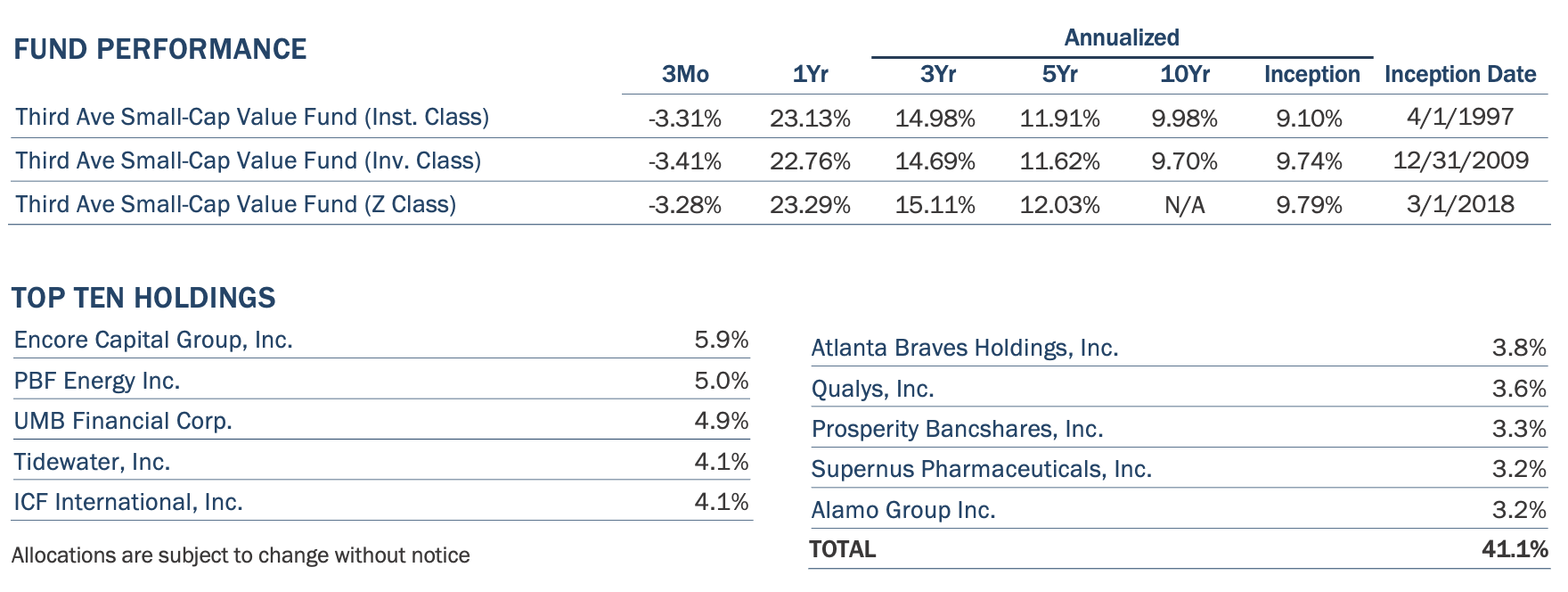
Past performance is no guarantee of future results; returns include reinvestment of all distributions. The above represents past performance and current performance may be lower or higher than performance quoted above. Investment return and principal value fluctuate so that an investor’s shares, when redeemed, may be worth more or less than the original cost. For the most recent month-end performance please visit the Fund’s website at www.thirdave.com. The gross expense ratio for the Fund’s Institutional, Investor and Z share classes is 1.26%, 1.51% and 1.20%, respectively, as of March 1, 2026.
Risks that could negatively impact returns include: fluctuations in currencies versus the US dollar, political/social/economic instability in foreign countries where the Fund invests, lack of diversification, volatility associated with investing in small-cap securities, and adverse general market conditions.
The fund's investment objectives, risks, charges, and expenses must be considered carefully before investing. The prospectus contains this and other important information about the investment company, and it may be obtained by calling 800-443-1021 or visiting www.thirdave.com. Read it carefully before investing.
Distributor of Third Avenue Funds: Foreside Fund Services, LLC.
Current performance results may be lower or higher than performance numbers quoted in certain letters to shareholders.
Third Avenue offers multiple investment solutions with unique exposures and return profiles. Our core strategies are currently available through '40Act mutual funds and customized accounts. If you would like further information, please contact a Relationship Manager at:


Notice
You are now leaving the Third Avenue Management website and being connected to a third-party website. Please note that Third Avenue Management is not responsible for the information, content or products(s) found on third-party websites.