


%402x.svg)
Notice
You are now leaving the Third Avenue Management website and being connected to a third-party website. Please note that Third Avenue Management is not responsible for the information, content or products(s) found on third-party websites.
Notice
Third Avenue Management is aware of recent incidents involving unauthorized individuals and groups falsely claiming to represent Third Avenue Management and its affiliates through social media platforms, messaging applications, email, and fraudulent websites. In some cases, these bad actors have used the names, photographs, or identities of Third Avenue employees in an attempt to appear legitimate.
These individuals and websites are not affiliated with, sponsored by, or endorsed by Third Avenue Management.
Third Avenue Management does not solicit investments, provide investment recommendations, or request personal or financial information through social media platforms or messaging applications such as WhatsApp, Telegram, Signal, or similar services.If you receive a suspicious communication claiming to be from Third Avenue Management, we encourage you to verify its authenticity before responding or providing any personal or financial information. If you are unsure whether you are communicating with an authorized representative of Third Avenue, please contact us directly using the contact information available on our official website.
Third Avenue Management, its affiliates, directors, officers, employees, and agents are not responsible for communications, representations, or activities conducted by unauthorized third parties. If you believe you have been the target of an impersonation or investment scam, or that you or someone you know has been a victim of fraud, please contact your local law enforcement agency and report the incident to the appropriate authorities. In the United States, suspected internet fraud can also be reported to the Federal Bureau of Investigation's Internet Crime Complaint Center (IC3) at https://www.ic3.gov/.
These individuals and websites are not affiliated with, sponsored by, or endorsed by Third Avenue Management.
Third Avenue Management does not solicit investments, provide investment recommendations, or request personal or financial information through social media platforms or messaging applications such as WhatsApp, Telegram, Signal, or similar services.If you receive a suspicious communication claiming to be from Third Avenue Management, we encourage you to verify its authenticity before responding or providing any personal or financial information. If you are unsure whether you are communicating with an authorized representative of Third Avenue, please contact us directly using the contact information available on our official website.
Third Avenue Management, its affiliates, directors, officers, employees, and agents are not responsible for communications, representations, or activities conducted by unauthorized third parties. If you believe you have been the target of an impersonation or investment scam, or that you or someone you know has been a victim of fraud, please contact your local law enforcement agency and report the incident to the appropriate authorities. In the United States, suspected internet fraud can also be reported to the Federal Bureau of Investigation's Internet Crime Complaint Center (IC3) at https://www.ic3.gov/.
Notice
You are now leaving the Third Avenue Management website and being connected to a third-party website. Please note that Third Avenue Management is not responsible for the information, content or products(s) found on third-party websites.
June 30, 2026
Real Estate Value Fund
Real Estate Value Fund Q226


Dear Fellow Shareholders,
We are pleased to provide you with the Third Avenue Real Estate Value Fund’s (the “Fund”) report for the quarter ended June 30, 2026. For the most recent period, the Fund generated a return of +5.99% (after fees). In comparison, the Fund’s most-relevant benchmark, the MSCI ACWI IMI Core Real Estate Index¹, generated a return of +8.21% (before fees) over the same time-period.
The primary contributors to performance during the quarter included the Fund’s investments in select residential (D.R. Horton and PulteGroup), commercial (U-Haul Holdings and WESCO), and international (Segro plc and Accor) holdings. Notwithstanding, these gains were slightly offset by detractors during the period, including the Fund’s investments in certain residential-centric (Sun Communities, Fannie Mae, and Freddie Mac) and international (Jardine Matheson and Hang Lung Group) holdings. Further insights into these enterprises, as well as the Fund’s most recent additions (Brookdale Senior Living, Lennar Corp. and Savills plc) and notable corporate developments (Segro and Prologis) are included herein.
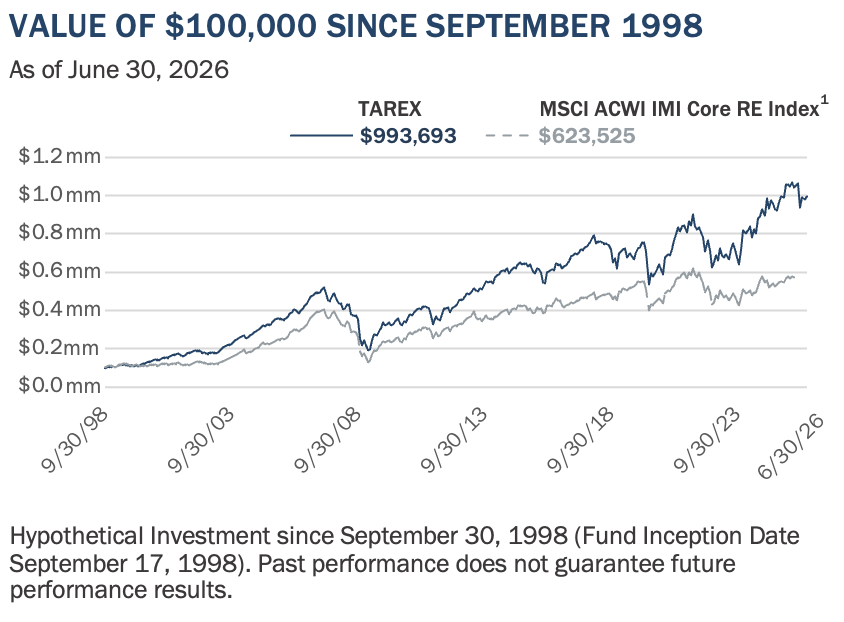
Recognizing that returns are likely to fluctuate from quarter-to-quarter, Fund Management believes the Fund’s long-term results are the most relevant scorecard. By that measure, the Third Avenue Real Estate Value Fund has generated an annualized return of +8.61% since its inception in 1998 (after fees). This performance also indicates that an initial investment of $100,000 in the Fund would have a market value exceeding $990,000 at quarter-end (with distributions reinvested)—or more than what the same $100,000 would have totaled in a passive mutual fund tracking the benchmark over the same period.
PORTFOLIO ACTIVITY
In June, the Joint Center for Housing Studies of Harvard University published its annual assessment of the U.S. residential markets. Widely read each year, The State of the Nation’s Housing 2026 report noted a moderation in home price growth and a decline in apartment rents nationally, among other shifts. However, affordability levels were deemed challenging in most instances, with the authors joining the call for the federal government to allocate additional resources to improve the outlook.
Attempting to address such issues, Congress passed the 21st Century ROAD to Housing Act in the quarter, with the legislative package expected to come into effect shortly. In Fund Management’s view, some of the most impactful portions of the ambitious bill include streamlined building codes, local zoning incentives, and restrictions on the “institutional ownership” of single-family rental properties. The legislation will also remove the federal “chassis requirement” for manufactured homes, placing this product type in a more competitive position moving forward—including Fund holding Champion Homes, the second largest producer of manufactured (and modular) homes in the U.S. with significant excess building capacity should incremental demand materialize.
During the quarter, other relevant bills were introduced in the U.S. House of Representatives, including several relating to Fund holdings Fannie Mae and Freddie Mac (collectively the “GSEs”)—leading providers of mortgage finance, as well as “mission critical” entities for the broader U.S. residential markets. More specifically, legislation was proposed to accelerate the process for these businesses to exit “conservatorship” given their record profitability and capital build. In addition, the text called for a portion of the U.S. Department of the Treasury’s (“Treasury”) investment in the GSEs to be allocated to affordable housing initiatives.
While certain elements of the proposals seem intriguing, it remains Fund Management’s view that the GSE’s path forward will more closely align with the framework presented in the Congressional Budget Office’s (“CBO”) 2024 report The Effects of Recapitalizing Fannie Mae and Freddie Mac Through Administrative Actions. While such plans may be more deliberate than first anticipated, it remains a process with the potential to surface significant value for GSE stakeholders, as well as build upon recent traction on the affordability front (i.e., by further improving “mortgage spreads”).
In the meantime, Fund Management is allocating capital to other pockets of listed real estate where strategic real estate platforms can also be attained on a value-basis—with the Fund adding to select real estate operating companies, residential-related business, and international holdings in the quarter.
As far as real estate operating companies, the Fund increased its position in Brookdale Senior Living (“Brookdale”) during the period. As covered in greater detail in the Fund’s previous shareholder letter, Brookdale is a leading owner and operator of senior housing properties in the U.S., with more than 500 communities and nearly 50,000 units. The company is also recognized for its strong brand, as well as its focus on serving private-pay residents within assisted living and memory care facilities.
Despite those attributes, Brookdale has spent the better part of this decade repositioning the company due to an ill-timed acquisition in 2015 (i.e., Emeritus). As a result, the company has failed to keep pace with its peers alongside the rebound in senior housing fundamentals following the Covid-19 Pandemic. In fact, Brookdale’s weighted-average occupancy rate was recently reported at 82.5% versus the national average of nearly 89.5%.
That said, it is not inconceivable to expect the reinvigorated control group at Brookdale to: (i) further improve upon the company’s profitability by boosting occupancy alongside supportive demand trends; (ii) utilize the company’s enhanced “free cash flow” profile to further reduce debt and resume tuck-in acquisitions; and (iii) engage in some degree of resource conversion with the company controlling the third largest portfolio of senior housing assets in the U.S., a property-type that is viewed to be increasingly scarce. In Fund Management’s view, each item would improve the company’s cost of capital (i.e., implied multiple), but all three “KPI’s” will need to be checked off to close the substantial discount to Net-Asset Value (“NAV”) that exists today.
In terms of residential-related businesses, the Fund increased its position in the B shares of Lennar Corp. (“Lennar”) during the quarter. A long-time holding in the Fund, Lennar is the second-largest homebuilder in the U.S. (by volume) having delivered more than 80,000 homes last year, with a particular focus on the first-time and first-time move-up buyers in major U.S. markets.
Notably, Lennar has recently completed a multi-year shift to a “land-light” operating strategy, whereby it controls most of its land positions through land banking or options arrangements. Such an approach generally leads to higher returns on capital, more elevated levels of free cash flow, as well as a more defensible business model with reduced debt levels and capital outlays. In combination, such an approach can also result in an improved cost of capital if effectuated at scale (e.g., the “NVR multiple”). However, that has not proven to be the case for Lennar so far. Instead, the company has prioritized volumes alongside the “land light” shift, thus compressing margins and overall profitability.
As far as Fund Management is concerned, there is a straightforward path back to more normalized levels of profitability though—primarily by striking a better balance between incentives and pace, improving upon the terms of certain land banking arrangements, and completing “IT upgrades”. Should such improvements transpire, Fund Management believes that Lennar’s earnings will reset at higher levels, with the potential to surface incremental value from ancillary investments (and share repurchases) along the way.
With respect to the Fund’s international holdings, Savills plc (“Savills”) was increased during the quarter. Also a long-time holding in the Fund, Savills is a U.K.-based real estate services company with a diversified business offering across brokerage, advisory, property management, and investment management on a global basis. The company is especially well-known for its conservative approach, having been in business since 1855, as well as its leading positions within the U.K. commercial and prime residential markets, as well as key markets in the Asia-Pacific region.
Close followers of Savills might note the company’s recent challenges in further scaling the business in North America. However, Savills recently announced a transaction that those same followers would likely recognize as an incredibly strategic fit: a combination with Eastdil Secured—a privately-held real estate capital markets business with a leading position in large-scale real estate transactions and debt advisory, particularly within major U.S. markets.
As a result, the “go forward” entity will be very well placed, in Fund Management’s view, with a strong financial position, resilient mix of recurring and transactional revenues, and well-designed incentives. In addition, the combined platform will likely realize cost efficiencies alongside enhanced prospects to win highly coveted “global mandates”, although such prospects don’t seem to be factored into Savills’ common stock. In fact, the shares imply a 40-50% discount to most “comps”, a level that is unlikely to persist following the anticipated closing of the deal later this year, in our opinion.
Alongside those additions, there was also a significant corporate development involving two existing holdings with Segro (a U.K.-based REIT that is the leading owner of industrial properties in the U.K. and Western Europe) receiving a proposal from Prologis (a U.S.-based REIT that is the largest owner of industrial and logistics facilities globally) to combine in an all-stock transaction. While the offer for Segro was nearly 20% above prevailing prices, the initial approach did not seem to factor in much value for the company’s asset management business nor a “change of control” premium. As a result, Prologis failed to receive support from Segro’s Board of Directors.
That said, Fund Management would expect an improved offer given precedent. Should one materialize, it is our opinion that it will offer merit for both sides if (i) the exchange ratio is adjusted to reflect an adequate “control premium” (e.g., 8-12% above NAV) and (ii) a “cash component” for U.K.-focused investors unable to own stock in the combined company. With a core position in both entities, Fund Management anticipates providing more details alongside related developments next quarter.
Outside of these items, the Fund’s activity was modest in nature. The Fund also added to other holdings where the price-to-value gap broadened during the period (FirstService Corp. and Hang Lung Group). Additionally, the Fund reduced various positions within the North American (D.R. Horton and WESCO International) and Asia Pacific (CK Asset Holdings and Wharf Holdings) regions, while extending its British Pound hedge.
POSITIONING
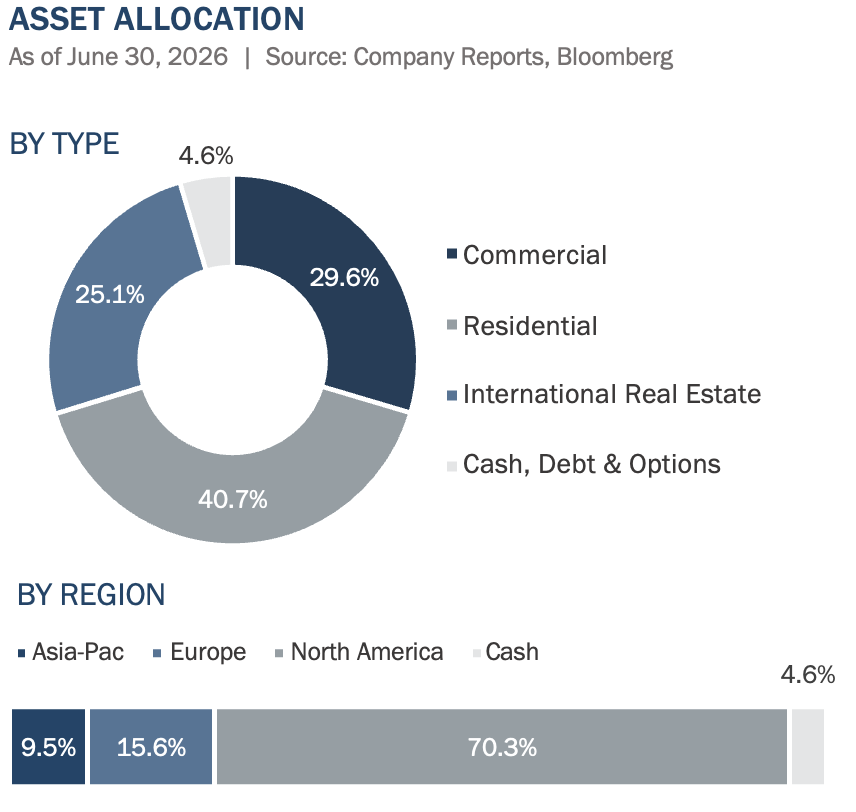
Following these changes, the Fund had 40.7% of its capital invested in U.S.-based companies focused on Residential Real Estate, including those involved with: Homebuilding (Lennar Corp., PulteGroup, D.R. Horton, and Champion Homes); Niche Rental Platforms (Sun Communities, AMH, and Brookdale Senior Living); Land and Timber (Five Point and Weyerhaeuser); and Mortgage and Title Insurance (Fannie Mae, Freddie Mac, and Fidelity National). In Fund Management’s view, each issuer has a well-established position in the residential value chain and is underpinned by supportive fundamental drivers, including: (i) notable demographic shifts, (ii) favorable supply-and-demand conditions, and (iii) industry dynamics favoring scaled players.
An additional 29.6% of the Fund’s capital is invested in North American-based companies involved with Commercial Real Estate, including: Real Estate Services (CBRE Group, JLL, and FirstService); Asset Management (Brookfield Corp.); Industrial and Logistics (Prologis, First Industrial, and Wesco); and Self-Storage (U-Haul Holdings). In Fund Management’s opinion, these holdings represent platforms that would be very difficult to reassemble. They also comprise select pockets of commercial real estate that seemingly favor long-term investors with (i) diverse demand drivers, (ii) limited maintenance “capex”, and (iii) prospects to “self-finance” value-enhancing investments.
The Fund also had 25.1% of its capital invested in International Real Estate companies. These holdings are largely focused on the same types of activities as outlined above, simply with leading platforms in their respective regions. At quarter-end, these included companies involved with: Commercial Real Estate (Big Yellow, CK Asset, Segro, Jardine Matheson, Hang Lung Group, and Wharf Holdings); Residential Real Estate (Berkeley Group and Ingenia Communities); and Real Estate Services (Savills and Accor).
The holdings are also listed in developed markets where Fund Management believes there are (i) adequate disclosures and securities laws and (ii) ample opportunities for resource conversion and change of control transactions (i.e., the U.K., Australia, France, Hong Kong, and Singapore).
The remaining 4.6% of the Fund’s capital is in Cash, Debt & Options. These holdings include U.S.-Dollar based cash and equivalents, short-term U.S. Treasuries, and hedges relating to certain foreign currency exposures (Hong Kong Dollar and British Pound).
The Fund’s allocations across these segments and geographies are outlined below. It also remains our view that when viewed in the aggregate, the portfolio represents “strategic real estate at value prices”. In other words, the Fund’s holdings include some of the premier real estate platforms globally, while trading at more than a 20% discount to our estimates of NAV at quarter-end, or nearly twice the long-term average.
FUND COMMENTARY
During the quarter, Third Avenue Management (“Third Avenue” or “the Firm”) participated in the Morningstar Investment Conference in Chicago where more than 2,000 investment professionals gathered to dissect investment trends. Some of the key themes evident on the “main stage” this year included the increasing convergence of public and private market investing and potential for Artificial Intelligence (“AI”) to augment all facets of the industry.
On the other hand, there was another theme “backstage”: a revitalized interest in distinct investment strategies given the prevailing valuations for broad-based equities. To that end, the Third Avenue team seemed uniquely suited for such conversations with the Firm’s Real Estate, Value, and Small-Cap strategies not only having high “active share”, but track records of exhibiting differentiated performance following previous stretches of elevated valuations (e.g., the early 2000s).
Fund Management was quick to point out though that the setup for listed real estate seems much more nuanced today. Put otherwise, listed real estate remains a key building block in the portfolio construction process, in our view, as an allocation offering exposure to essential businesses with resilient cash flows, as well as inflation attributes and portfolio diversification benefits. However, for those that focus exclusively on U.S. Real Estate Investment Trusts (“REITs”), there are other key considerations to factor in when comparing the current environment to previous periods, including:
- Diverging Exposures: The investable universe for listed real estate has expanded considerably over the past 25 years, with the equity market capitalization of U.S. REITs increasing by more than 20-fold since 2000. Alongside this growth, the REIT sector now includes many “non-traditional” property types (e.g., gaming, timber, cold storage, etc.) as well as data infrastructure (e.g., data centers, cellular towers, and fiber-based broadband) that entail varied fundamental drivers.
- Increased Concentration: Several benchmarks for listed real estate (and passive REIT funds) have become noticeably more concentrated in recent years. For instance, the top 15 constituents of the RMZ Index (a widely followed U.S. REIT Index) accounted for more than 60% of the investable universe at the end of 2025 versus nearly 40% in 2000. Single-company concentration has increased as well with the largest U.S.-based REIT (Welltower) accounting for more than 12% of the index at quarter-end relative to less than 6% in a single name back in 2000 (Equity Office Properties).
- More Demanding Valuations: U.S. REITs are also trading at more elevated valuations than previous periods. In fact, the U.S. REIT sector was trading at more than 23 times free cash flow (“AFFO”) at the end of the quarter, relative to less than 10 times in 2000 per Citi Research. The sector is also cited to be trading at more than a 20% premium to NAV when measured on a market-cap-weighted basis—largely due to the increased concentration of certain companies and sectors (e.g. senior housing, data centers, towers, net lease, etc.).
These factors are not meant to suggest a lack of opportunities in the U.S. REIT space. There are several. Instead, the considerations simply reinforce Fund Management’s view that an actively managed approach will remain valuable when navigating listed real estate. In addition, adding exposure to more modestly valued pockets of real estate that sit outside the U.S. REIT sector could enhance an allocation over time (e.g., real estate operating companies, residential-centric businesses, international property companies, etc.).
In that regard, the Third Avenue Real Estate Value Fund seems ideally positioned with a more expansive real estate universe than most, as well as a 25-plus year track record of capitalizing on opportunities across the real estate value chain. The Fund’s flexible mandate also allows for capital to be directed to a select-set of issuers, irrespective of whether they are included in relevant benchmarks.
As a result, the Third Avenue Real Estate Value Fund seems to represent a differentiated portfolio within listed real estate. To wit, the Fund not only includes investments across the commercial, residential, and real estate services sectors on a global basis. The portfolio is also comprised of holdings with more conservative financial positions and modest valuations than its benchmark, by our estimates, with a net-debt-to-asset ratio of less than 15%, on average, and securities trading near a 22% discount to the team’s conservate estimates of NAV, in the aggregate. Equally as notable, the Fund has elected to sidestep certain pockets of the real estate market where valuations may not prove as durable when factoring in certain fundamental items over an extended period (e.g., technological obsolescence, maintenance capex, tenant concentration, refinancing headwinds, etc.).
Fund Management recognizes that there will inevitably be periods when the strategy will look “out of step” with such positioning (which has been the case for the past two quarters). As the team also pointed out at the Morningstar conference though, it is not our expectation for the strategy to outperform “all of the time”. Instead, it is Fund Management’s goal to outperform over the long-term—the prospects of which have increased, in our view, not only due to the price-to-value proposition for the Fund’s holdings, but also the evolving setup for broader equities and U.S. REITs.
We thank you for your continued support and look forward to writing to you again next quarter. In the meantime, please don’t hesitate to contact us with any questions or comments at realestate@thirdave.com.
Sincerely,
The Third Avenue Real Estate Value Team

IMPORTANT INFORMATION
This publication does not constitute an offer or solicitation of any transaction in any securities. Any recommendation contained herein may not be suitable for all investors. Information contained in this publication has been obtained from sources we believe to be reliable, but cannot be guaranteed.
The information in this portfolio manager letter represents the opinions of the portfolio manager(s) and is not intended to be a forecast of future events, a guarantee of future results or investment advice. Views expressed are those of the portfolio manager(s) and may differ from those of other portfolio managers or of the firm as a whole. Also, please note that any discussion of the Fund’s holdings, the Fund’s performance, and the portfolio manager(s) views are as of June 30, 2026 (except as otherwise stated), and are subject to change without notice. Certain information contained in this letter constitutes “forward-looking statements,” which can be identified by the use of forward-looking terminology such as “may,” “will,” “should,” “expect,” “anticipate,” “project,” “estimate,” “intend,” “continue” or “believe,” or the negatives thereof (such as “may not,” “should not,” “are not expected to,” etc.) or other variations thereon or comparable terminology. Due to various risks and uncertainties, actual events or results or the actual performance of any fund may differ materially from those reflected or contemplated in any such forward-looking statement. Current performance results may be lower or higher than performance numbers quoted in certain letters to shareholders.
Date of first use of portfolio manager commentary: July 10, 2026
1 The MSCI ACWI IMI Core Real Estate Index is a free float-adjusted market capitalization index that consists of large, mid and small-cap stocks across 23 Developed Markets (DM) and 24 Emerging Markets (EM) countries engaged in the ownership, development, and management of specific core property type real estate. The index excludes companies, such as real estate services and real estate financing companies, that do not own properties. Results for the index are inclusive of dividends and net of foreign withholding taxes.
For the Third Avenue Glossary please visit here.
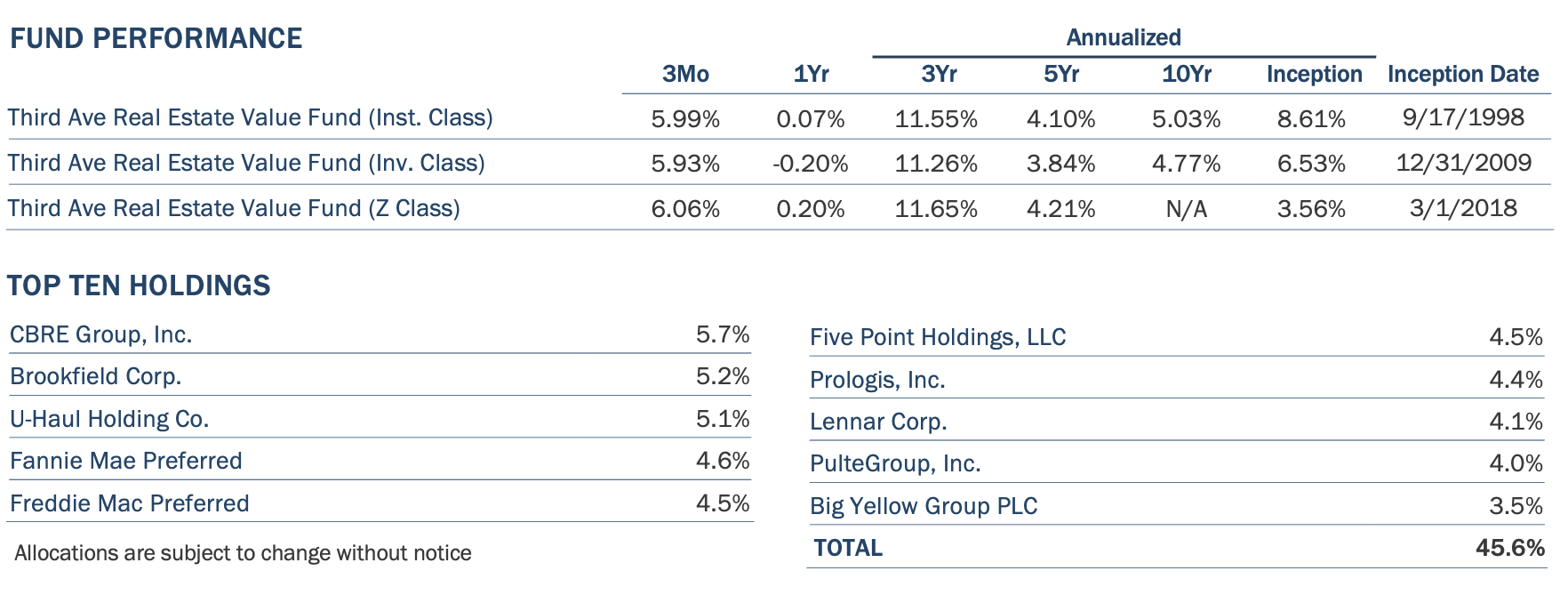
Past performance is no guarantee of future results; returns include reinvestment of all distributions. The above represents past performance and current performance may be lower or higher than performance quoted above. Investment return and principal value fluctuate so that an investor’s shares, when redeemed, may be worth more or less than the original cost. For the most recent month-end performance, please visit the Fund’s website at www.thirdave.com. The gross expense ratio for the Fund’s Institutional, Investor and Z share classes is 1.18%, 1.43% and 1.11%, respectively, as of March 1, 2026.
Distributions and yields are subject to change and are not guaranteed.
Risks that could negatively impact returns include: overbuilding and increased competition, increases in property taxes and operating expenses, lack of financing, vacancies, environmental contamination and its related clean-up, changes in interest rates, casualty or condemnation losses, and variations in rental income.
The Morningstar Rating™ for funds, or “star rating,” is calculated for mutual funds, variable annuity and variable life subaccounts, exchange-traded funds, closed-end funds, and separate accounts) with at least a three-year history. Exchange-traded funds and open-ended mutual funds are considered a single population for comparative purposes. It is calculated based on a Morningstar Risk-Adjusted Return measure that accounts for variation in a managed product’s monthly excess performance, placing more emphasis on downward variations and rewarding consistent performance. The top 10% of products in each product category receive 5 stars, the next 22.5% receive 4 stars, the next 35% receive 3 stars, the next 22.5% receive 2 stars, and the bottom 10% receive 1 star. The Overall Morningstar Rating for a managed product is derived from a weighted average of the performance figures associated with its three-, five-, and 10-year (if applicable) Morningstar Rating metrics. The weights are: 100% three-year rating for 36-59 months of total returns, 60% five-year rating/40% three-year rating for 60-119 months of total returns, and 50% 10-year rating/30% five-year rating/20% three-year rating for 120 or more months of total returns. While the 10-year overall star rating formula seems to give the most weight to the 10-year period, the most recent three-year period has the greatest impact because it is included in all three rating periods. Morningstar Rating is for the Institutional share class only; other classes may have different performance characteristics.
©2026 Morningstar, Inc. All Rights Reserved. The information contained herein: (1) is proprietary to Morningstar and/or its content providers; (2) may not be copied or distributed; and (3) is not warranted to be accurate, complete or timely. Neither Morningstar, nor content providers are responsible for any damages or losses arising from any use of this information. Past performance is no guarantee of future results.
The fund's investment objectives, risks, charges, and expenses must be considered carefully before investing. The prospectus contains this and other important information about the investment company, and it may be obtained by calling 800-443-1021 or visiting www.thirdave.com. Read it carefully before investing.
Distributor of Third Avenue Funds: Foreside Fund Services, LLC.
Current performance results may be lower or higher than performance numbers quoted in certain letters to shareholders.
Third Avenue offers multiple investment solutions with unique exposures and return profiles. Our core strategies are currently available through '40Act mutual funds and customized accounts. If you would like further information, please contact a Relationship Manager at:


Notice
You are now leaving the Third Avenue Management website and being connected to a third-party website. Please note that Third Avenue Management is not responsible for the information, content or products(s) found on third-party websites.